
How Modern Technologies Reduce Time Waste
Every second counts in online learning. Slow page loads waste users’ time. Full page reloads interrupt learning. Repeated delays make even simple navigation frustrating. Reducing this wasted time is therefore an important challenge for both developers and platform owners.
The question is: how exactly do modern technologies reduce this wasted time? What simple solutions do developers use, and how do they work?
Four ways to reduce time waste
Modern web technology offers four practical solutions:
- Client-side navigation
- Prefetching
- Caching
- Automatic code splitting
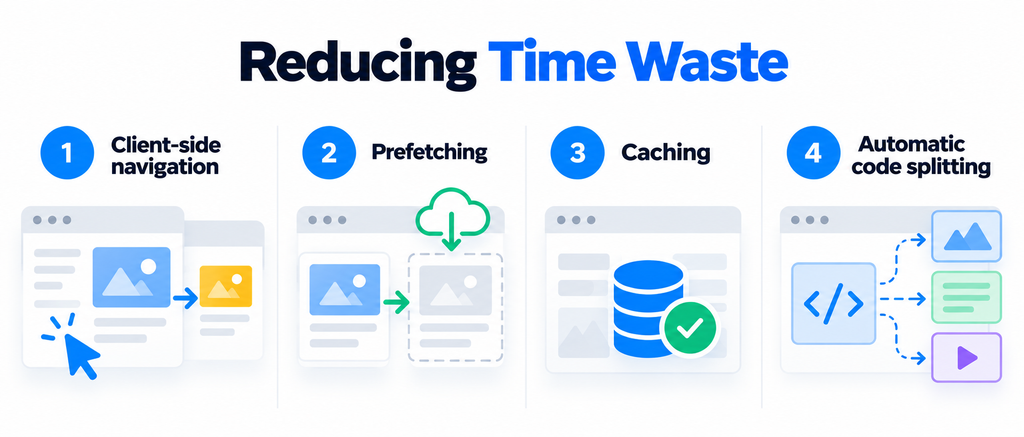
Frameworks such as Next.js, developed by Vercel, combine these technologies to make navigation faster and avoid repeatedly loading everything from scratch.
Client-side navigation
Client-side navigation eliminates unnecessary full page reloads. Instead of discarding the current page and loading another one from scratch, the browser updates only the content that needs to change. The rest of the interface stays in place.
Prefetching
Prefetching prepares content before the user asks for it. Next.js, for example, can automatically prefetch linked routes when they enter the browser viewport. When the user clicks, some of the resources required for the next page may already be available.
Caching
Caching keeps previously retrieved data and resources available for reuse. Instead of requesting the same information from the server again, the browser or application can use what it already has, reducing both server requests and waiting time.
Automatic code splitting
Automatic code splitting prevents the browser from loading application code it does not currently need. Next.js splits code by route, so users download what is required for the page they are using rather than the entire application.
Together, these technologies replace the traditional pattern of repeatedly loading complete pages with faster, more targeted updates.
What uMOVA is building
That said, uMOVA began developing EdTech solutions that reduce unnecessary waiting and make online learning faster, smoother, and more enjoyable. We started with LearnPress, where full page reloads between lessons and quizzes create exactly this kind of unnecessary interruption.
Our first solution is uMOVA Smooth Lessons for LearnPress, a WordPress plugin that removes unnecessary full page reloads while preserving LearnPress functionality and course structure. The Free version provides smooth lesson-to-lesson navigation and lesson completion confirmation. Smooth Lessons Pro adds instant lesson-to-quiz, quiz-to-quiz, quiz-to-lesson, and quiz-retake transitions.
For learners, this means faster navigation, uninterrupted focus, and more enjoyable learning. For platform owners, it means more revenue: users stay longer, complete their courses, and are more likely to return and buy again.
Besides, we’re making user profiles faster and easier to navigate. uMOVA Instant Profile removes full-page reloads when switching between the tabs such as Lessons, Quizzes, and Settings (for avatars, bios, and personal info), and more.
What Can You Improve?
How much time do your users lose waiting for pages to reload? How often do these interruptions break their focus? Which of these technologies does your platform already use, and which are still missing? Which solutions are most relevant today, and which ones are worth implementing in your product?
At uMOVA, we applied client-side navigation to LearnPress with Smooth Lessons, replacing unnecessary full page reloads with instant transitions between course items.
Learn more about our plugins → here.