

Why Users Leave Online Learning Platforms
People do not like waiting, and online learning is no exception. Every delay counts. A learner clicks Next and waits for a new page. They open a quiz and wait again. They confirm a completed lesson or restart a quiz — and wait again. One delay may seem harmless. But repeat it 20 or 100 times, and patience runs out. Frustrated users leave.
With that in mind, let us analyze the hidden cost of waiting. For example, Google/SOASTA found that increasing mobile load time from 1 to 3 seconds raised the probability of a bounce by about 32%. In a survey of 1,602 MOOC learners, 45.5% said difficult navigation could push them to drop a course.
The problem of waiting
Users do not care what makes them wait, be it a slow server, overloaded database, heavy WordPress theme, inefficient plugin, or LMS architecture. They click, nothing happens, they leave.
Whatever causes the delay, waiting is the problem. Most often, it comes in three forms: loading, response, and navigation.
Google’s INP standard
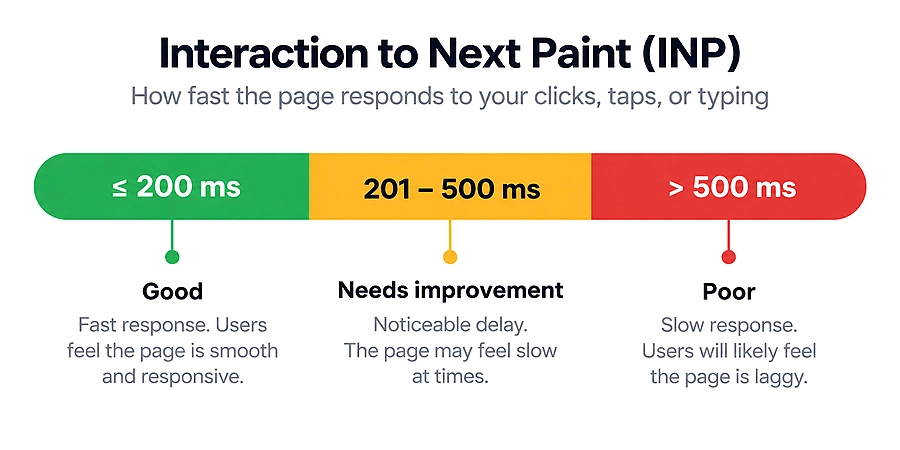
Loading is not the only problem. A platform can load quickly but respond slowly to clicks, taps, or typing. Google measures this with Interaction to Next Paint (INP): 200 milliseconds or less is considered good, while more than 500 milliseconds is poor.
Another problem is poor navigation. Users have to search for content, close unnecessary pop-ups, or struggle to return to previous topics. Not to mention frequent full page reloads they have to deal with, turning online learning into a nightmare.
What Google, Akamai, Deloitte, and Portent found
Research clearly shows how waiting affects online behavior. Google, Akamai, Deloitte, and Portent studied different websites, markets, and user actions. Their numbers differ, but the pattern is remarkably consistent: slower digital experiences lose users and conversions.
Google/SOASTA Research published in 2017 found that when mobile page load time increased from 1 to 3 seconds, the probability of a bounce increased by 32%. At 5 seconds, the increase reached 90%. At 6 seconds, it was 106%, and at 10 seconds it reached 123%.
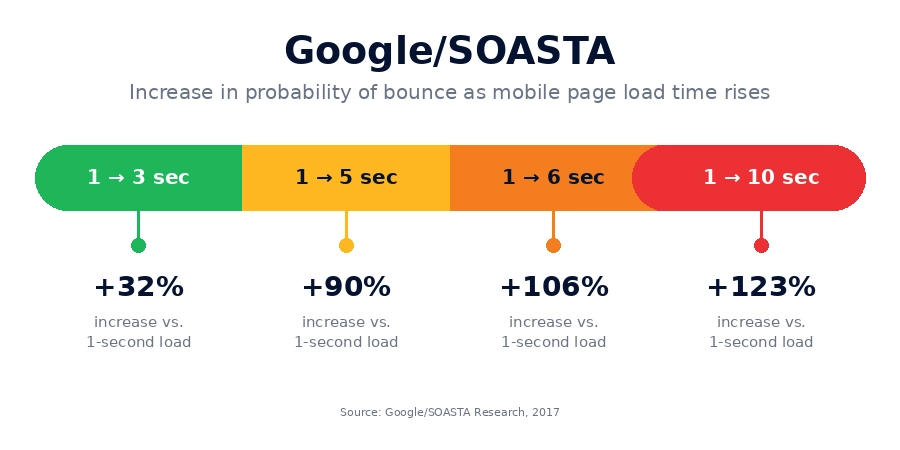
Google summarized the finding in a simple sentence: “No matter what, faster is better and less is more.”
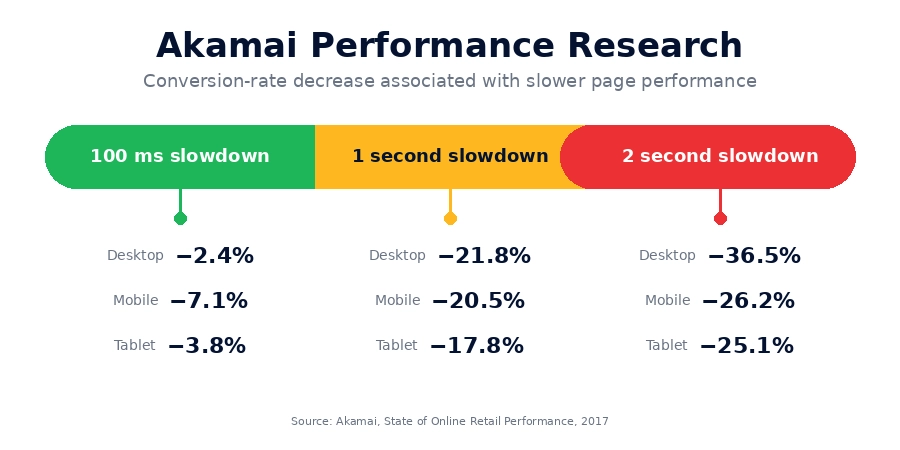
Akamai’s 2017 Performance Research found measurable differences at an even smaller scale. A 100-millisecond slowdown was associated with conversion-rate decreases of 2.4% on desktop, 7.1% on mobile, and 3.8% on tablets. A one-second slowdown was associated with decreases of 21.8%, 20.5%, and 17.8% respectively.
At a two-second slowdown, desktop conversion rates were 36.5% lower, mobile rates were 26.2% lower, and tablet rates were 25.1% lower. Akamai captured the point in four words: “Even tenths of a second count.”
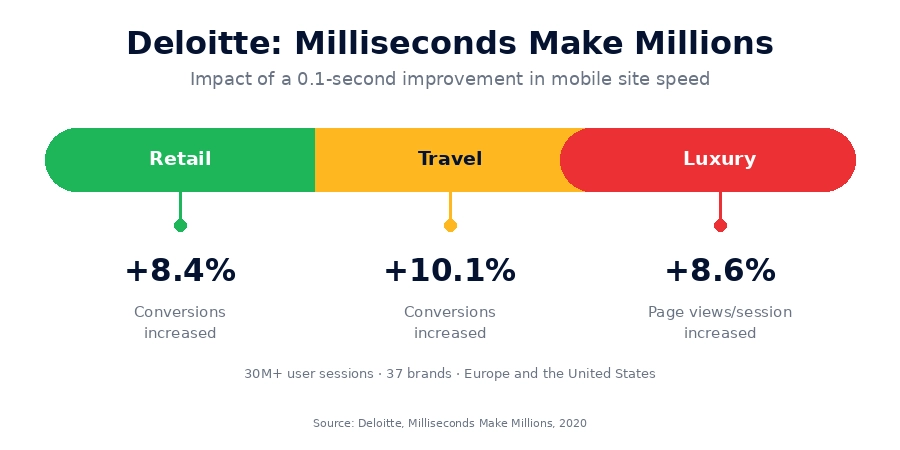
Deloitte looked at what happened when mobile websites became only 0.1 seconds faster. Its study covered more than 30 million user sessions across 37 brands in Europe and the United States. Retail conversions increased by 8.4%, travel conversions by 10.1%, and page views per session for luxury brands by 8.6%.
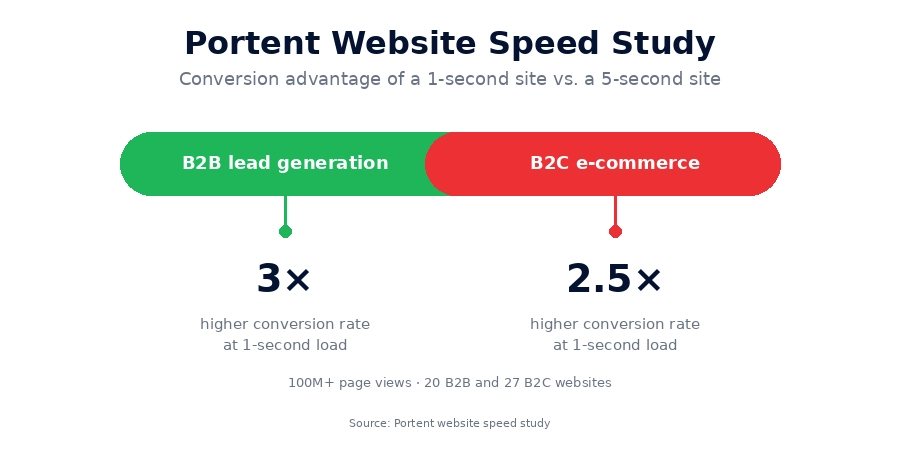
Michael Wiegand, Director of Analytics at Portent, examined how page speed affects conversions in B2B lead generation and B2C e-commerce using the agency’s own client data. The study analyzed a 30-day snapshot covering more than 100 million page views across 20 websites, with page-speed data from 5.6 million sessions. A B2B site loading in one second had three times the conversion rate of one loading in five seconds. For B2C e-commerce, the difference was 2.5 times.
These four studies provide strong evidence from different angles. Google measured abandonment, Akamai tracked conversion losses from delays as small as 100 milliseconds, Deloitte tested the gains from making mobile sites just 0.1 seconds faster, and Portent compared conversion performance across B2B and B2C businesses.
Speed determines whether users stay or leave, convert or abandon — and whether your product makes or loses money.
How uMOVA Reduces Waiting
At uMOVA, we develop WordPress plugins that reduce wasted time in online learning. One example is Smooth Lessons for LearnPress LMS, which eliminates unnecessary full page reloads and makes learning faster, smoother, and more enjoyable.
Besides improving the learning experience, we’re also making user profiles faster and easier to navigate. Our new plugin, uMOVA Instant Profile, eliminates full-page reloads when switching between both main (vertical) and secondary (horizontal) tabs, including Lessons, Quizzes, and Settings (where users manage their avatars, bios, and other personal information), and more.
Questions for You
What about your LMS? How long do users wait between actions? Where do full page reloads still interrupt their experience? Which delays could you eliminate today? Take a fresh look at your platform from the user’s perspective.



To the point! All those “reloads” drive me nuts. I wait only when I need a particular “service” badly. Google, Akamai, Deloitte, and Portent – good one! Google’s INP standard was useful. Deloitte’s shocking — just 0.1 second faster and 8–10% higher conversion rates!
Deloitte’s 0.1 second faster → 8–10% higher conversion… Probably agree. Akamai’s breakdown is useful, but it was in 2017. I don’t think anything changed radically since, though.